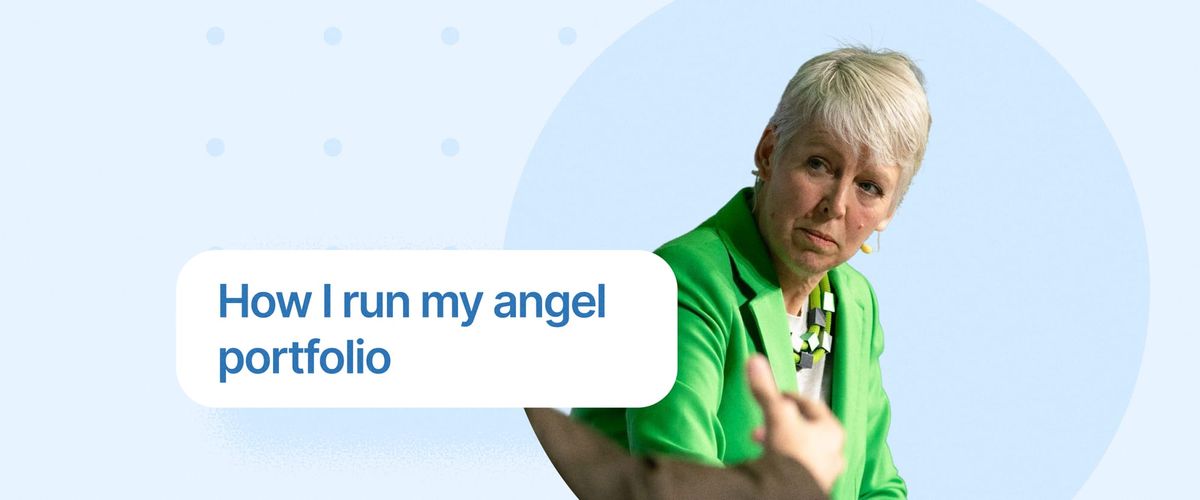

You don't have to be rich to become an angel investor
This is an edited version of the talk I gave at the Investors Alliance Forum on 10 September 2026.
I'm Vicky Brock, a five-time founder turned angel investor. I am not a billionaire. Sadly, I am not even a millionaire — my average first investment into a company is typically only about €7,000.
Maybe it's my British-born arrogance. Maybe it's an entrepreneur's delusion. Either way, I am completely convinced that with your help I can still amplify potential and change the world for the better.
It is simpler than you might think.
Small actions need to happen at scale
This forum already recognises that talk is not enough and awareness is not enough. Actions matter more than good intentions. But my handful of investments, on their own, are not enough either. Small actions like mine need to happen at scale to have real impact. None of us can do this alone.
More than ever before in my lifetime, our communities, our regions and our local economies urgently need hope. To create hope we need meaningful jobs and innovation — visible evidence that people inside our own community are working on, and supporting, solutions to the problems that matter most.
The founder is an essential part of that. So is the community around them. All of us can deliver impact by actively supporting the ideas that matter: action that goes beyond PR, likes and awards, and instead directly funds the startups that solve real-world problems, create jobs, and rebuild the places nobody else is investing in.
I am not talking about charity. I am talking about positive societal and financial returns.
Local, not extractive
That takes funding. And I strongly believe investment should be inclusive and localized, so that the rewards are fairly shared and not extractive, not in the hands of a distant global elite. The rewards should find their way back to the place where the risk was taken, and to the people who had the original courage to act.
It is through a diverse base of investors, with the moral ambition to provide very early-stage funding to ideas they believe in, that we enable founders to create the solutions and the meaningful work our local economies so desperately need.
Who invests decides which problems get solved
Diversity among investors is just as critical as diversity among founders. People are naturally drawn to support the ideas and the problems they understand and need themselves. If early money only ever comes from one narrow slice of society, then only that slice's problems get solved.
Women investing at scale, alongside men, means that the founders we back, also the problems we choose to fund, start to represent all of us, rather than a male minority.
It is not enough to not be one of the bad guys. It is not enough to simply not be evil. We have to do the much harder job of making the good things we want in the world actually happen.
We don't all need to be founders to do that. We can do it by being direct and deliberate with our money, our time and our experience. Every one of us has the power to use those personal resources to amplify ambition through investment.
And the positive changes this makes to our communities and economies cannot wait for some future perfect day when institutions, regulators, scale-up funds, bond markets, interest rates, oil prices and the stars all finally align.
First, an honest word about risk
Early-stage investing is very high risk, illiquid, and not for everyone. You should only ever invest what you can afford to lose in its entirety.
But for those of us who can afford to take that risk, I believe it is the most rewarding, most interesting and genuinely most fun thing I can do with some of my savings.
To be clear, I am not suggesting anyone rushes out to hand €5,000 to the first person with a half-formed idea who asks. I personally get maybe 200 asks a month, and I invest in about six deals a year. And although I sometimes invest independently, I never invest alone. That is how I mitigate some of the risk.
The argument that actually lands
The most impactful conversation I have had about diverse investment this year was with Michiel Smith of Apollo Informal Ventures, in a room full of attentive men at the EBAN congress.
It landed precisely because he made the case through rational self-interest. He argued that diverse decision-making improves investment outcomes: first, by harnessing the wisdom of the crowd within the group making the decision, and second, by extending the pool of potential deals to include the diverse, non-obvious businesses that represent solid opportunities for angel-scale returns — rather than only chasing the big outlier bets.
How to start: find a group, and don't invest alone
The best way to start investing is to join a local angel group, and there are several represented here today, including Sebastian and the Business Angels Club Berlin-Brandenburg. I belong to groups in Norwich and in Tallinn, and I started simply by going along to a meeting as a guest.
If you genuinely can't find a local group, find a friend and start one. Once you have other people with different perspectives around you, the people you feel comfortable investing alongside, the wisdom of the crowd kicks in. Our decisions get better with every new contributing member of the group, and the impact potential of our investments improves along with them.
It is my experience that women like investing with other women. We like to do things properly. We do our homework. And we notice founders and solutions that an all-male group might overlook. Women aren't just an underused source of capital — we're backing an underused pool of founders too.
Doing that homework properly is also why I ended up working on the investor product at Dealum. I wanted a way to track my portfolio updates, support my founders and understand my own performance as an angel and I wanted to do it right from day one, rather than reconstruct it later out of memory and inbox search.
Then add into the mix the women with the niche expertise to run due diligence on a specific technology. Or the financial background to recognise deal terms and valuations that make no sense. Or simply the personal perspective to say: yes, I would use that, and I know a local route to market.
Unloved places, overlooked communities, underserved problems. New businesses are what will fix them and no founder can do it alone.
Start now. Start local.
To quote the anthropologist Margaret Mead and to credit the Dutch author Rutger Bregman, whose work on moral ambition has inspired me so much:
"Never doubt that a small group of thoughtful, committed citizens can change the world. Indeed, it's the only thing that ever has."
Awareness is not enough. Idealism is not enough. We need a process and a tasklist for change. And that change is possible.
We start now. We start local. We take the required actions ourselves — without asking nicely for permission, and without waiting for perfect conditions or perfect information.
And founders: when this community helps you and your team succeed, you come back. To this place, with these people. You stand where I am standing. And we do it all over again.