
How I run my angel portfolio with Dealum's Investor Plus
I don't invest only for the money, and I'm not unusual in that. My own research with angel investors shows that most of us are not in it purely for financial return, especially those of us who invest directly.
For me, two things also matter. I champion founders, and I back businesses that do good. I only invest where I can see a positive social impact, and I want to be genuinely useful to the founders I back.
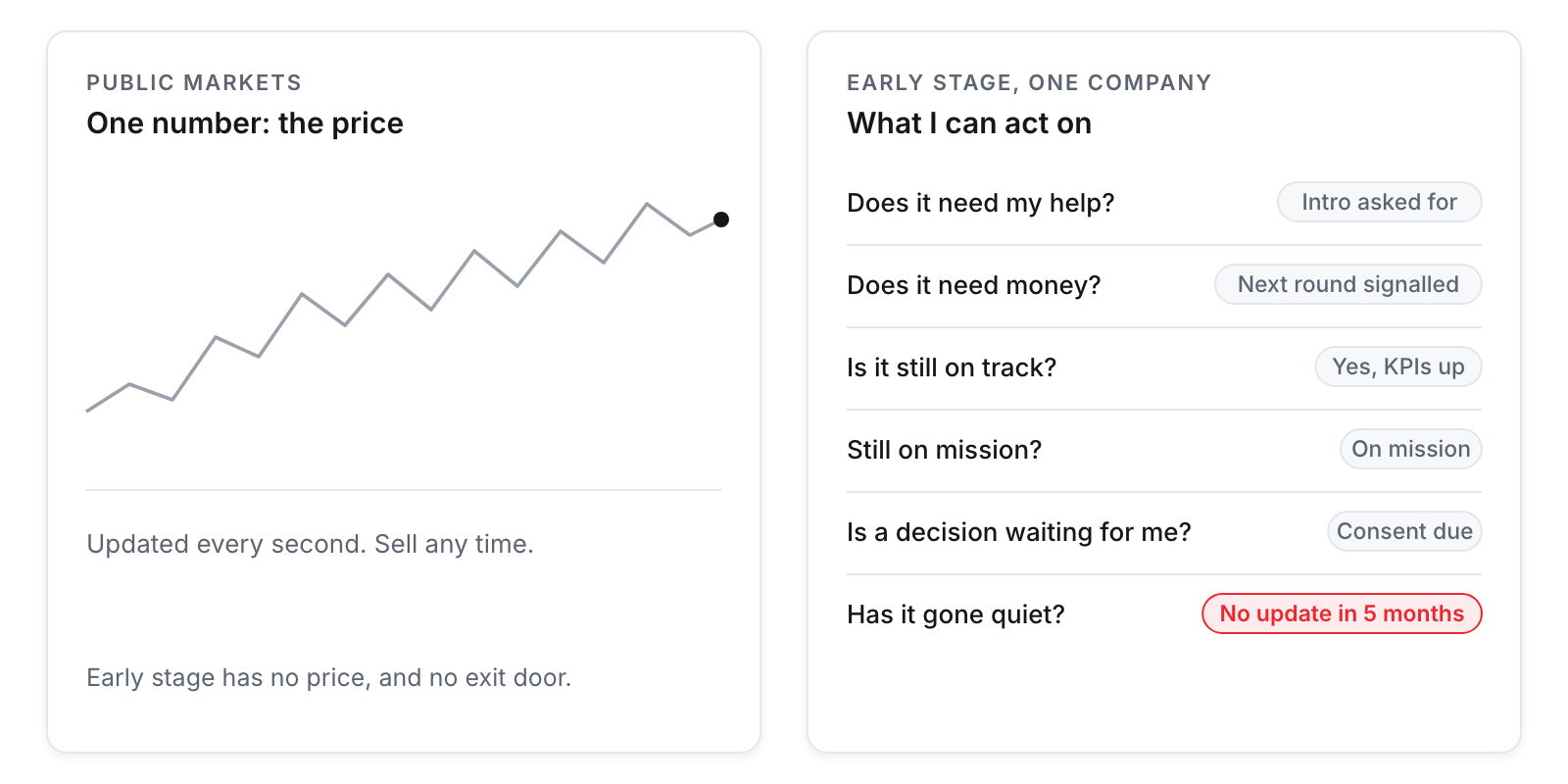
Early stage investing is illiquid. I can't sell a share when I'm worried or have an unexpected expense, and most of the companies I back won't have a meaningful valuation event for years. So I gave up trying to measure my portfolio the way a public market investor would.
Instead, I measure what I can act on. Does this company need my help? Does it need money? Is it still on track, and still doing the good it set out to do? Is there a decision waiting for me, a follow-on, a consent, a tax filing? And sometimes the hardest one: has it gone quiet, and what does that silence mean?
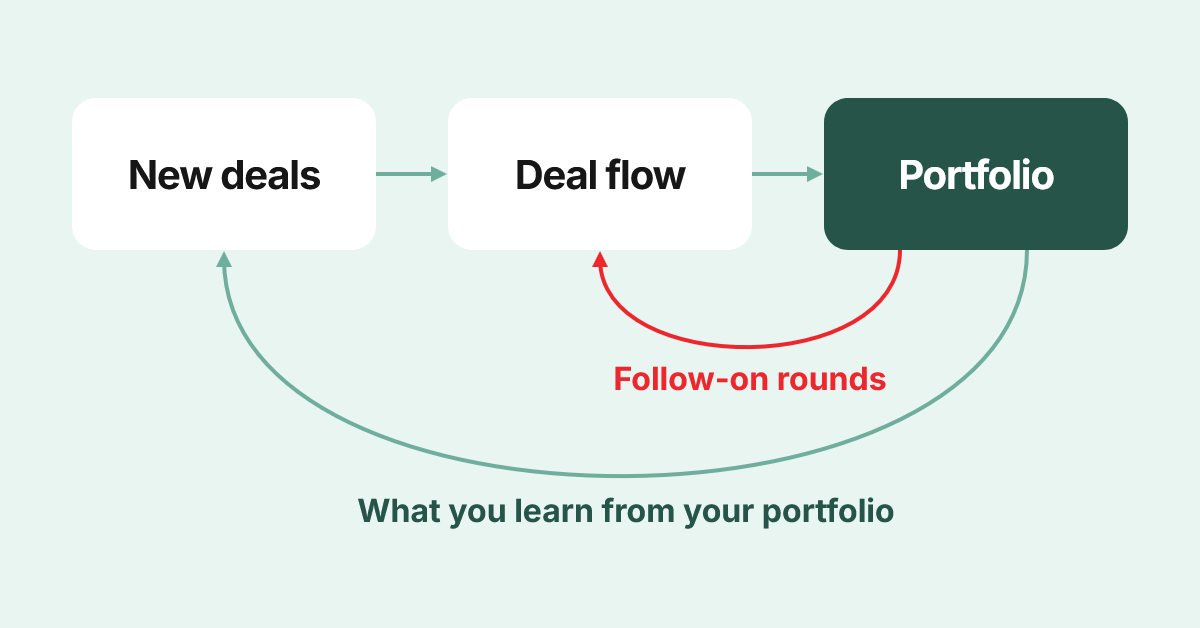
Measuring what matters also shapes what I do next. It tells me which new companies fit my thesis, how much I can sensibly commit, and whether to follow on in the companies I already back. What I learn from my portfolio informs my deal flow funnel, and the best of my funnel becomes my portfolio.
It is a closed loop, and one I maintain myself, using a tool that is fit for purpose to make better decisions.
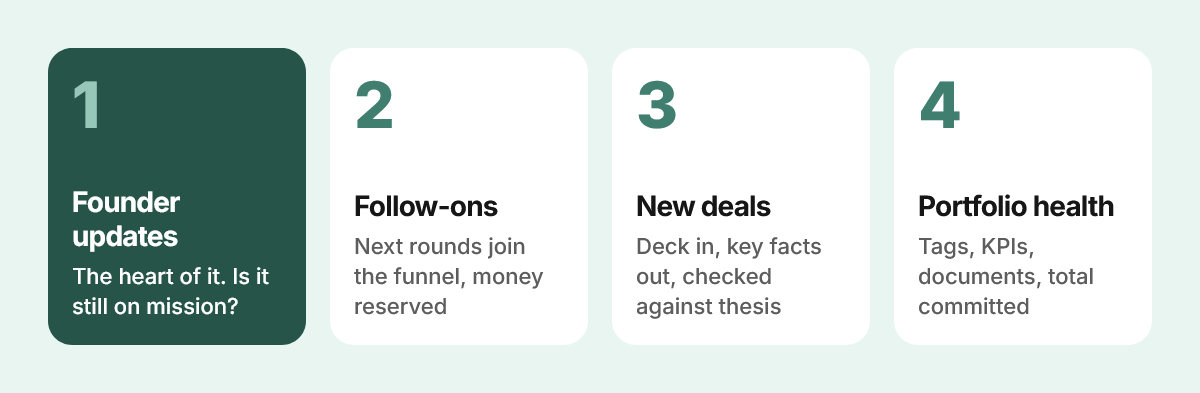
The four parts of Investor Plus I rely on
The decisions are all mine, but the analysis behind them is supported by AI. There are four parts of it I rely on, and here they are in order of importance to me.
1. Portfolio company updates and reports
This is the heart of it for me. When a founder sends me an update or a report, I forward the email to Investor Plus, where it is automatically uploaded, analysed and scored. Everything relating to each company's performance builds up in one place over time, instead of sitting in my inbox.
This is where I answer the questions above, company by company, including the one that matters most to me: is it still on mission? A company can drift away from its purpose and still do well commercially. But it has drifted from why I backed it, and I want to notice early, while there is still a conversation to have. Your own lens might be a sector, a particular community of founders, or financial return. Whatever it is, drift from it is worth noticing.
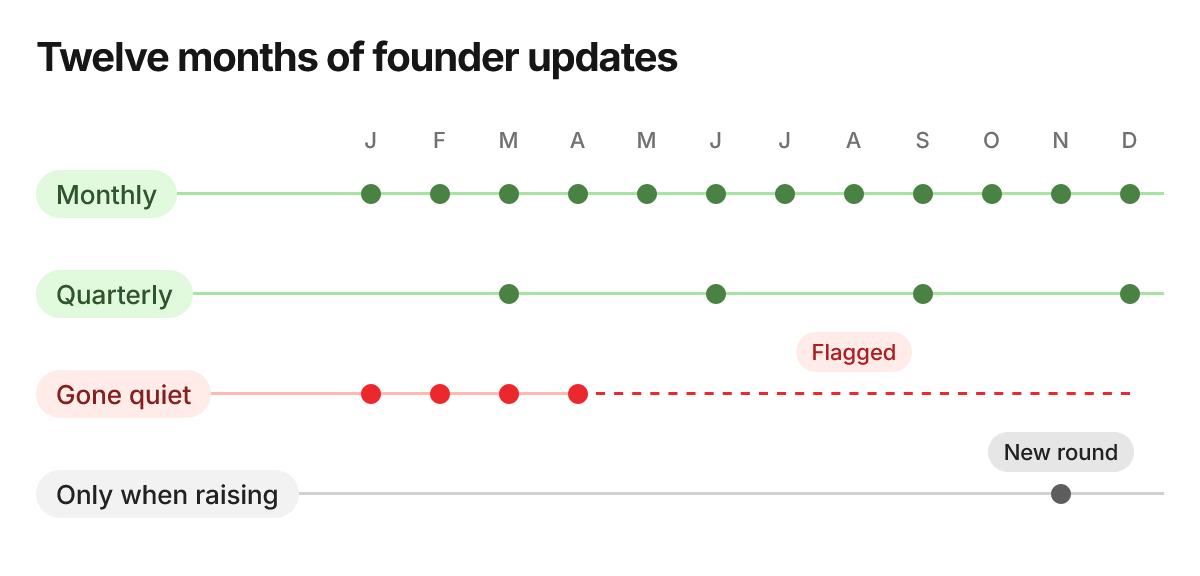
Updates also show me who has gone quiet. The founders I champion are the ones who keep me updated and tell me how I can help. The ones who only get in touch when they are raising? Not so much. When updates stop, that tells me something. Sometimes it means a team with its head down. Sometimes it means trouble, or that I need to chase. And sometimes, eventually, it means a write-off.
Write-offs are part of this asset class. Many of the companies any angel backs will fail, which is why experienced investors look hard at the deal, not just the idea. I would rather record a write-off honestly than carry a number I know isn't real.
2. Follow-ons: tracking my portfolio companies' next rounds
What my portfolio companies tell me in their updates often signals their next round. When it does, I add that round to my deal flow funnel, right alongside the new deals competing for the same money. I can see what capital to reserve for companies I already back, and it stops me overcommitting.
3. New deals, from every source
New deals reach me by email, through LinkedIn, and from conversations at events. Some come through the screening I do for Anglia Capital Group. The most interesting ones make it into my funnel.
Adding a deck takes seconds. Investor Plus pulls in the deck itself, and AI extracts and maps the key information, so I go into pitch meetings and screening calls already informed. Most importantly for me, it helps me judge quickly whether a deal really matches my investment thesis.
When I decide to invest, I simply move the company from my funnel into my portfolio. From then on, its updates feed back into everything above.
4. Portfolio health as a whole
The first three are about individual companies. This one is about my whole portfolio.
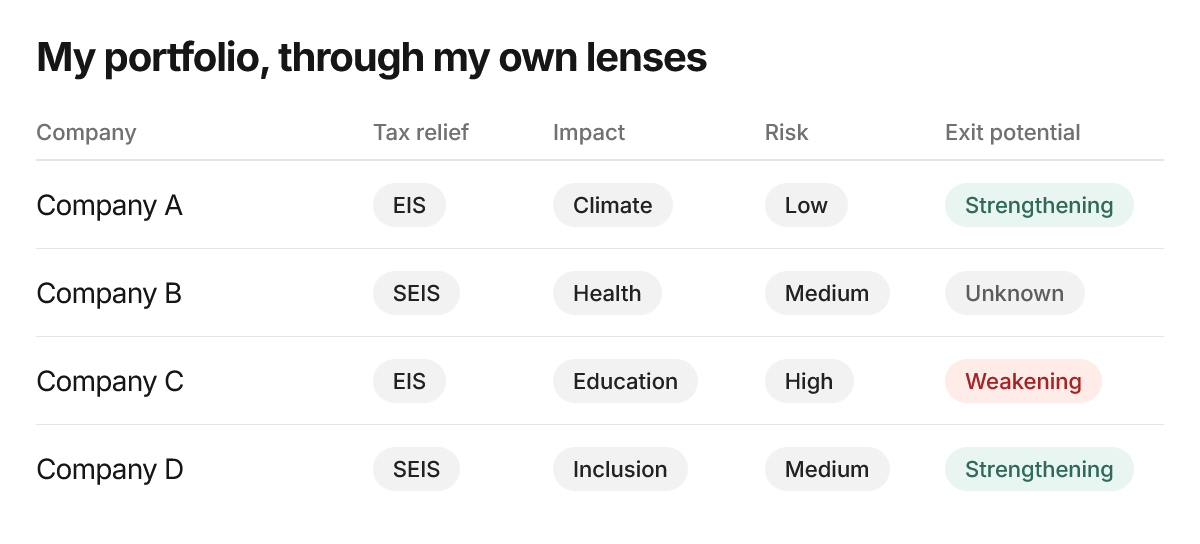
I customise the KPIs and metrics I track across all my portfolio companies, so I can compare like with like. I tag each company for what matters in my context: SEIS and EIS status, impact, female founder, deal source and risk. I also tag exit potential, based on my own judgement.
Tags in Investor Plus are entirely my own. An angel in Oslo or a health tech specialist would set them up differently, and that is the point. Filters then let me look across my whole portfolio through any of those lenses, and review its risk factors as a whole.
My documents sit here too. Term sheets, share certificates and contracts are in one place, so I can see my pre-emption and reporting rights without digging through old emails. When a consent, a follow-on or a tax filing comes up, usually at short notice, I can check what I am entitled to and answer quickly.
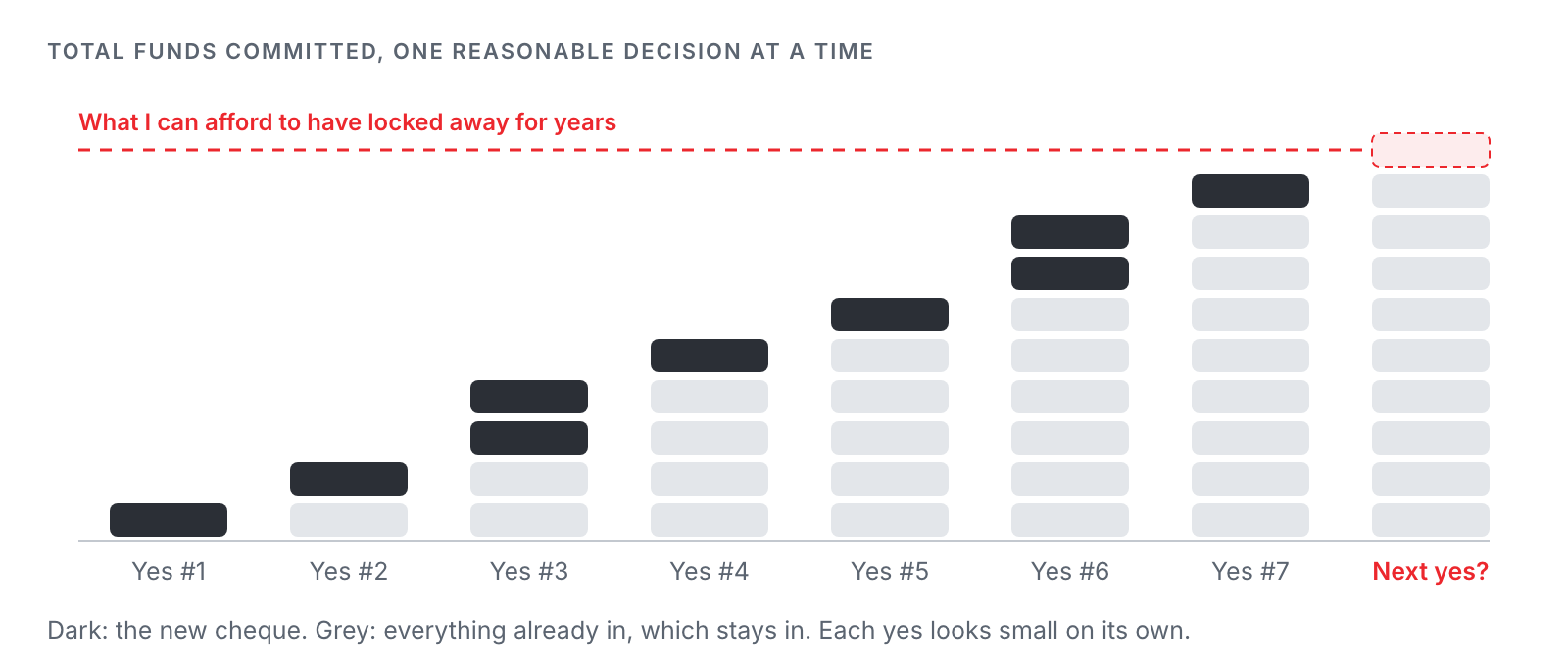
And there is the one number I always keep in view: total funds committed. Money that goes in stays in, often for many years, and some of it won't come back. It is easy to overcommit one small cheque at a time, because each decision feels reasonable on its own. The Investor Plus dashboard shows me the total at a glance, so I can be sure I am not overexposing myself before I say yes to the next one.
Why illiquidity changes what I measure
A public market investor watches a price. I don't have one. The valuation from a company's last round tells me what someone paid at the time. It says little about current performance or market conditions.
Listed companies also have to report regularly, which keeps markets transparent and investors confident. Startups have no equivalent requirement, nor should they. Founders' time is best spent running their companies (to a point). What I do have are the reporting rights in my investment agreements, and founders who choose to keep me in the loop.
I can wait for perfect information, which never comes. Or I can decide what I can reasonably know, and act on that. For me, that means a regular email update from each portfolio company, which I forward to Investor Plus, and being ready to respond when a founder asks for help.
Measuring what matters inside a network
Most of my investing happens alongside other angels. My advice to new angels is always the same: start small, invest with others, and start local or in a sector you understand.
But investing with others doesn't mean handing over your judgement. The better I know my own portfolio, the better a co-investor I am. I know what I can commit before a new deal is presented. I know when a company needs something I can genuinely offer, and when to step back. I can be clear about my personal investment thesis and say yes or no quickly, for the right reasons.
That is what measuring what matters means to me as an individual angel. Not a perfect valuation, but a clear view of why I invest, the founders and companies I back, my commitments and my next decisions.
Find out more
I am always happy to show other angels how I set things up, peer to peer. I'm next at EBAN's European Angel Investment Summit (EAIS) 2026 in Luxembourg on 14 October, talking about Measuring What Matters. If you're there, come and find me.
If you would like to try this approach on your own portfolio, you can start a free Investor Plus trial on the Dealum website.
Investor Plus
Measure what matters in your own portfolio.
Start with one company and one update. Forward the next founder email and Investor Plus builds the view from there: updates analysed, quiet companies flagged, your total commitment always in sight. The decisions stay yours.